Khanal Group

Stock, stores and purchasing

K-Stock — what you hold, where it is, what it is worth and what to buy

Items and their units, every warehouse, bin and lot, each receipt, issue and transfer in one ledger, purchase orders and goods receipts with inspection, stock reserved for orders, and what is running low.

Who it is for

Indian companies that buy, store and issue material: contractors with a central store and site stores, manufacturers and traders, with storekeepers, purchasers and accounts staff working from one stock ledger.

Features

Screens from Aarav Infra Projects, one of our demo companies, on our staging server. Every name, number and email address in them is made up.

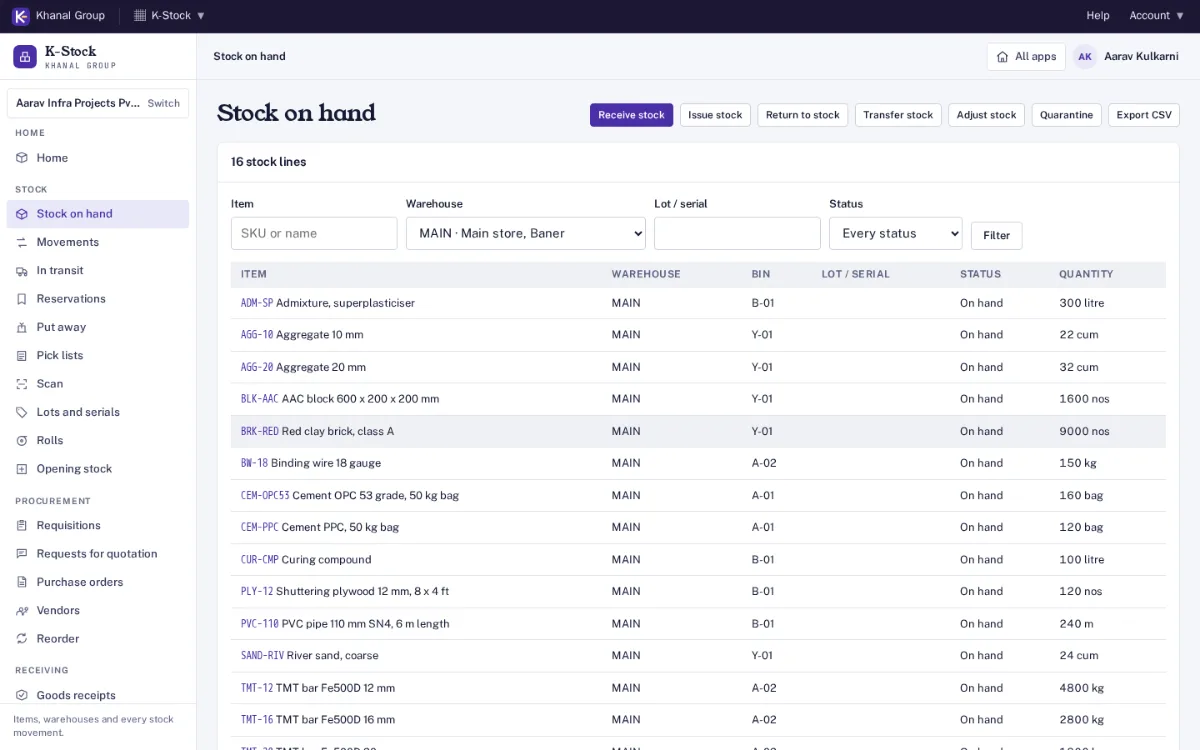
K-Stock stock on hand for Aarav Infra Projects Pvt Ltd, filtered to the main store in Baner: demo construction materials by SKU with warehouse, bin, lot, status and the quantity in the item's unit, with the receive, issue, transfer and adjust actions.

Stock on hand, by store and bin

Every stock line of the organisation: the item, the warehouse and bin it sits in, its lot or serial, its status and the quantity in the item’s own unit. Filter by item, warehouse, lot or status, and export the list.

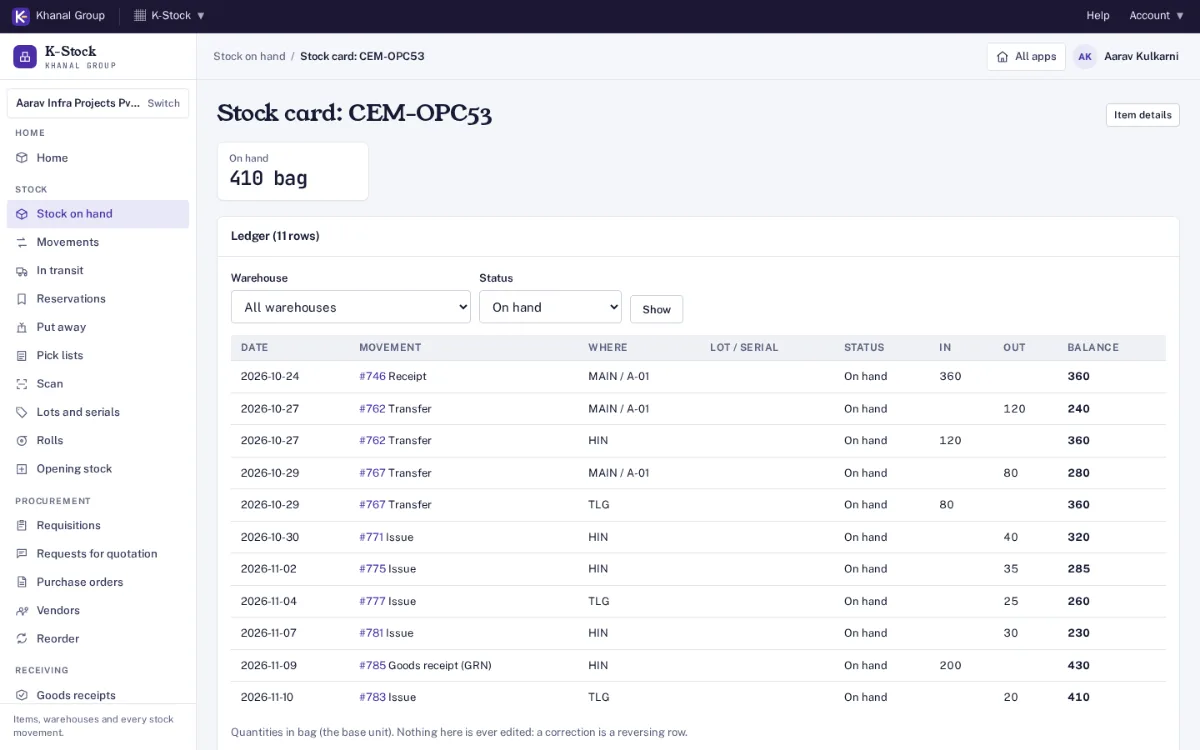
K-Stock stock card of cement OPC 53 for Aarav Infra Projects Pvt Ltd: 410 bags on hand and an 11-row ledger of the demo receipt into the main store, transfers to two site stores, site issues and a goods receipt, each with in, out and running balance.

One ledger per item

The stock card shows every movement of an item with its running balance: the opening receipt, transfers between stores, issues at site and goods receipts. Nothing is edited or deleted; a mistake is a reversing row.

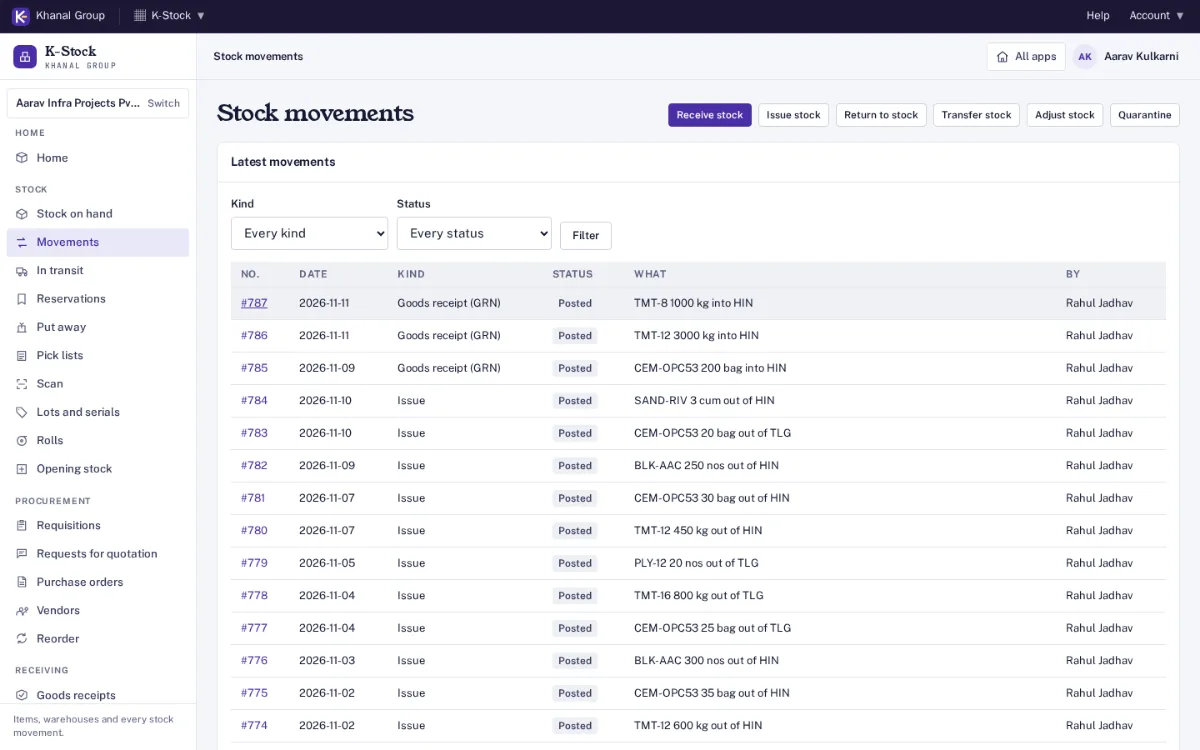
K-Stock stock movements of Aarav Infra Projects Pvt Ltd, newest first: demo goods receipts into the Hinjewadi site store and issues of cement, sand, steel, blocks and plywood from the site stores, each posted, with the storekeeper who posted it.

Movements, posted by name

Receipts, issues, returns, transfers, adjustments and quarantine moves in one list, newest first, with who posted each and which ones wait for approval. Receive, issue, transfer or adjust stock from the same screen.

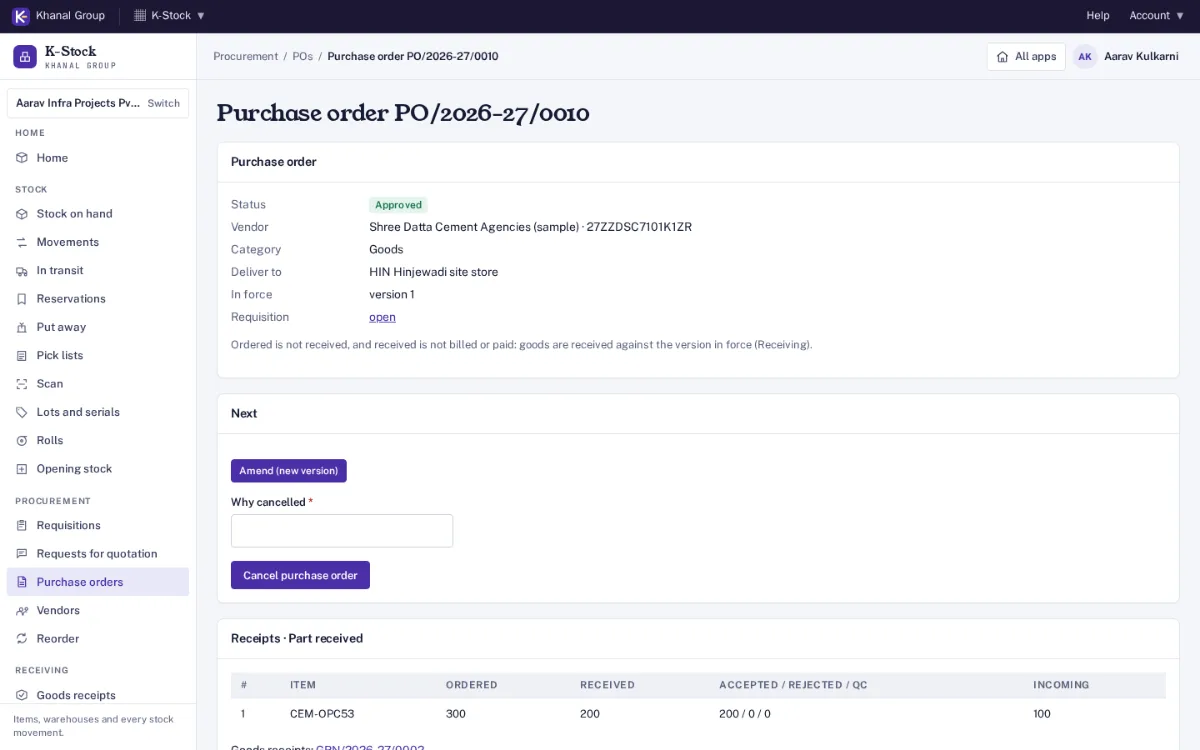
K-Stock purchase order PO/2026-27/0010 of Aarav Infra Projects Pvt Ltd to a demo cement vendor: approved, goods, delivered to the Hinjewadi site store, version 1, raised from a requisition, with amend and cancel, and the receipt progress of 300 bags ordered, 200 received, 100 incoming.

Purchase orders with maker and checker

A purchase order is raised by one person and approved by another, within the organisation’s approval limit. Amendments make a new version; the receipt progress shows ordered, received, accepted and incoming for every line.

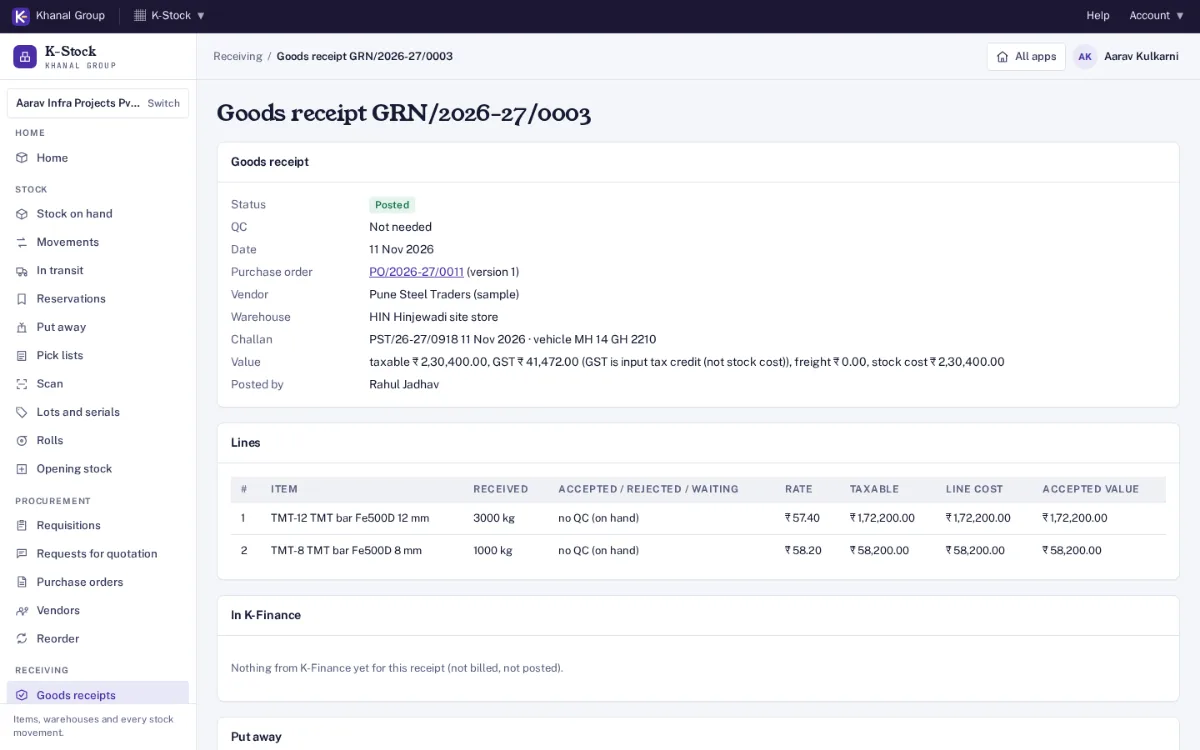
K-Stock goods receipt GRN/2026-27/0003 of Aarav Infra Projects Pvt Ltd: posted against a demo steel purchase order into the Hinjewadi site store, with the challan and vehicle, the taxable value, GST and stock cost, two TMT bar lines with rate, taxable and accepted value, the K-Finance billing status and put-away.

Goods receipts against the order

Goods are received against the purchase order version in force, within the over-receipt tolerance, with challan, vehicle, freight and GST. Items that need a quality check go into quarantine first; the receipt then reaches K-Finance for billing and the put-away list.

What it does

Items and units

Items with variants and categories, each with its base unit and exact conversions to the units you buy and issue in (a box of 12, a roll in square metres). Import and export the item list as CSV.

Warehouses, bins and lots

Warehouses for each company of your group, bins inside them, and lots and serial numbers, with expiry dates for the items that have one. A storekeeper can be limited to the warehouses they run.

One stock ledger

Receipts, issues, returns, transfers, adjustments, quarantine and opening stock are movements in one ledger. A movement is never edited or deleted: a mistake is reversed. Every night the balances are checked against the ledger.

Valuation and month close

Moving average or FIFO, worked out from the ledger. Closing a month freezes its values, and nothing can be dated in a closed month. Valuation reports with CSV and Excel downloads.

Purchasing

Requisitions, requests for quotation to your vendors (add them in K-Stock, or use your K-Finance vendor list if you have K-Finance), each with a quote link that you send to the vendor yourself, a comparative statement, and purchase orders with an approval limit and numbered amendments.

Goods receipts and inspection

A goods receipt against the purchase order, within its tolerance. Items that need inspection wait in quarantine; accepted stock is valued, rejected stock never is. Returns to the vendor, supplier claims and landed cost.

Reservations

Stock reserved for a sales order, or put on hold, cannot be issued for anything else. Release a reservation or deliver it in parts; available-to-promise is what is left free.

Put away, pick, pack and hand over

Put-away tasks from each goods receipt, pick lists from reservations with the earliest-expiring lots first, packing into packages, and hand-over to K-Logistics for dispatch. Only the delivery moves stock.

Labels and scanning

Labels with a QR code and a barcode for items, bins, lots and packages, and a scan page that opens what a label names.

Roll cutting

Rolls are received with their length and width. A cut is planned, approved by another person and made in one step; the pieces and the remnant keep their history, and the roll’s cost is split by area.

Reorder suggestions

A reorder level, quantity and maximum for each item and warehouse. A daily check counts what is on hand, reserved, on order and requested, and suggests a transfer from another store or a purchase. Nothing is ordered by itself.

ABC, ageing and slow stock

ABC analysis by the value that went out in a period you choose, the age of the stock you hold, and lists of slow and dead stock.

Approvals by another person

The person who raises a requisition or a purchase order, posts a goods receipt or plans a cut does not approve it. Above the approval limit only an organisation admin approves.

Roles and audit trail

Organisation admin, stock manager, storekeeper, purchaser and viewer. Every change is written to an audit log linked as a hash chain.

What it does not do

No bills of materials or production orders yet, no GST returns and no e-way bills. K-Stock makes no accounting entries: the books stay in K-Finance.

Data handling. Each company is a separate organisation; one organisation can never see another's items, stock, vendors or purchase orders. Records are kept in a database on Khanal Group servers in India.

Works with

  • K-Logistics: once the two are linked, a purchase order goes there as an inbound shipment, its delivery comes back as a goods receipt for the storekeeper to post, and packed orders are handed over for dispatch.
  • K-Finance: once linked, stock movements go to K-Finance with their values, and its sales orders reserve and deliver stock here.
  • K-Projects: once linked, a project’s material purchases and stock are kept in K-Stock, and their cost goes back to the project.
  • Khanal ID: one sign-in, and the shared directory of buyers and suppliers, through which your K-Finance vendors reach K-Stock.

Free calculators and guides for this work

Free, no sign-in. All calculators · All guides

What’s new

  1. K-Stock
    K-Stock is live

    Items and units, warehouses, bins and lots, one stock ledger with moving-average or FIFO valuation and month close, requisitions, RFQs, purchase orders and goods receipts with inspection, reservations, put-away and pick, labels with QR codes, roll cutting, reorder suggestions, ABC and ageing. Standard 15 users, Business 60 users; also in the Construction suite and Khanal One.

  2. Across the apps
    Accessibility pass across the apps and the site

    A skip link is the first Tab stop in every app, focus rings are visible on every control, no text is below 12 px, links on the site are at least 24 px tall, and colour contrast was checked page by page. Reported gaps are fixed as they come in.

  3. Across the apps
    Khanal One is live: paid plans and payments open in every app

    From 9 November 2026 every Khanal app sells its plans in the app, with the Founding Offer (half price until 31 March 2027 for the first 50 organisations per app) as published on the pricing page. K-Stock opened on the same day. Trials stay 14 days; nothing changes for an organisation until it chooses a plan.

Every update →

Price

K-Stock is part of Khanal One: ₹999 per user a month, or ₹499 at the Founding price for the first 12 months (code FOUNDING26, for organisations that sign up by 31 March 2027, first 50 per product). Every feature of K-Stock and of the other Khanal One apps is included, with no caps on projects, companies, leads, shipments, employees or storage, and the apps are connected automatically. One user is one person in every Khanal One app; for example, 10 users = ₹9,990 a month before GST. Yearly = 10 × monthly (₹9,990 per user). Prices exclude GST. Trial: 14 days of Khanal One, no card needed. If you already pay for a K-Stock plan, you keep it until it ends, then move to Khanal One at your renewal: details. All subscriptions and the offer: pricing.

Questions

Who is it for?

Indian companies that buy, store and issue material and want one place to see what they hold, where, in which lot and at what value: contractors with central and site stores, manufacturers and traders, with storekeepers, purchasers and accounts staff.

Can a wrong entry be corrected?

Yes, by reversing it. A stock movement is never edited or deleted, so the ledger always shows what happened and who did it. A goods receipt or an inspection decision is reversed from its own page while its stock has not been used.

How is stock valued?

By moving average unless you choose FIFO before the first month is closed, worked out from the ledger. Stock waiting for inspection and rejected stock are not valued; landed cost is added to the receipt it belongs to.

Does it order from vendors by itself?

No. A reorder suggestion is only a proposal. A purchaser turns it into a requisition, and someone else approves it before a purchase order is made.

Does it post into K-Finance?

K-Stock keeps the stock and its value; the books stay in K-Finance. Once the two are linked, every stock movement goes to K-Finance with its value.

How do I sign in?

With your Khanal ID, the same sign-in used for every Khanal Group app.

How much does it cost?

K-Stock is included in Khanal One: ₹999 per user a month, or ₹499 at the Founding price for the first 12 months. That covers every feature of K-Stock and of the other Khanal One apps, with no caps. Yearly is 10 × monthly. Prices exclude GST. Trial: 14 days, no card needed.
Trial, limits and price: pricing grid. Material moving between sites and suppliers is tracked in K-Logistics; the site work itself runs in K-Projects, and the books in K-Finance.