K-IPO — SME IPO readiness workstreams, documents and open items
A working desk for companies and advisers preparing for an SME IPO: workstreams, documents and open items in one place.
Beta. This product is in active development with early users. Features change frequently; tell us what your team needs.
Who it is for
Promoters, CFOs and company secretaries of companies preparing for an SME platform listing, and their advisers.
Features
Screens from Sunrise Agro Foods, one of our demo companies, on our staging server. Every name, number and email address in them is made up.
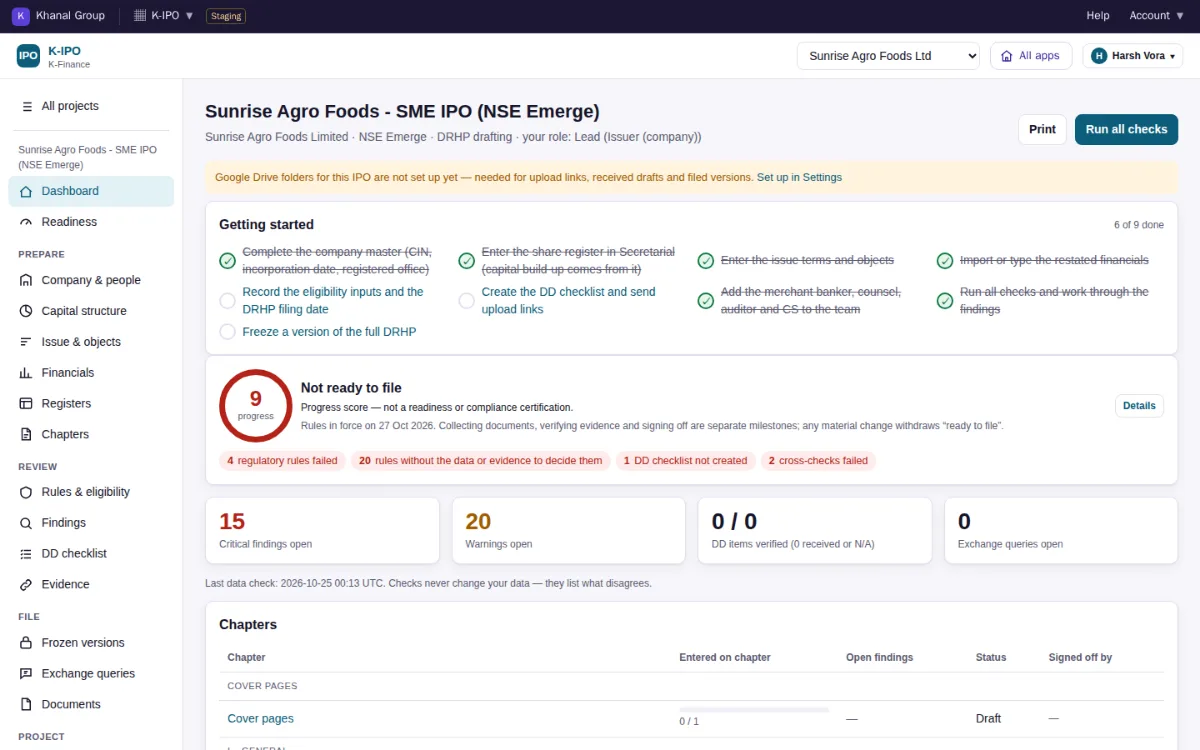
A getting-started list for the issue, ticked off as each step is done.
A progress score that names what still blocks filing. It is not a readiness certificate.
Open findings, warnings, verified DD items and exchange queries.
Each DRHP chapter with its open findings, status and sign-off.
Issue dashboard and progress score
Each SME IPO project opens on a getting-started list, a progress score with what still blocks filing, open critical findings and warnings, DD items verified, exchange queries and the status of every chapter.
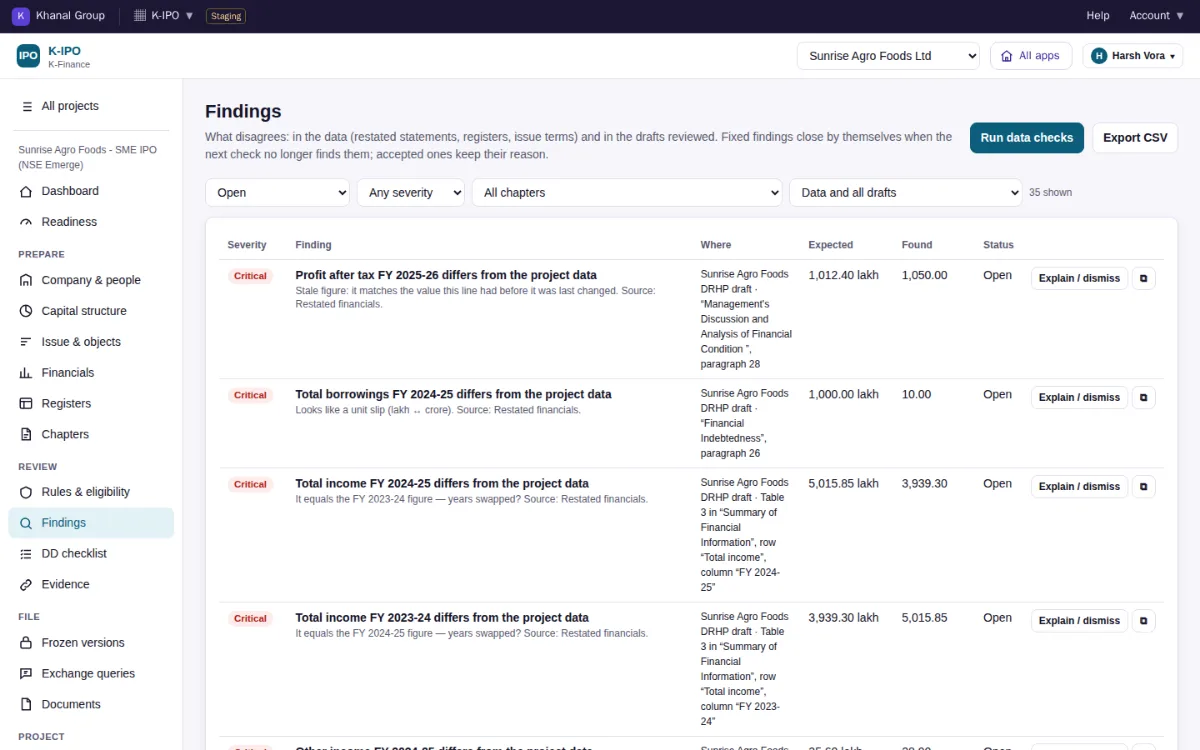
Severity of each finding.
What disagrees, with a hint such as a lakh and crore slip or swapped years.
Where in the draft offer document it was found.
Fix it in the draft, or explain or dismiss it with a reason.
Checks on the draft offer document
Data checks compare figures in the draft with the restated financials and list every disagreement as a finding, with its severity and where it was found, to fix, explain or dismiss.
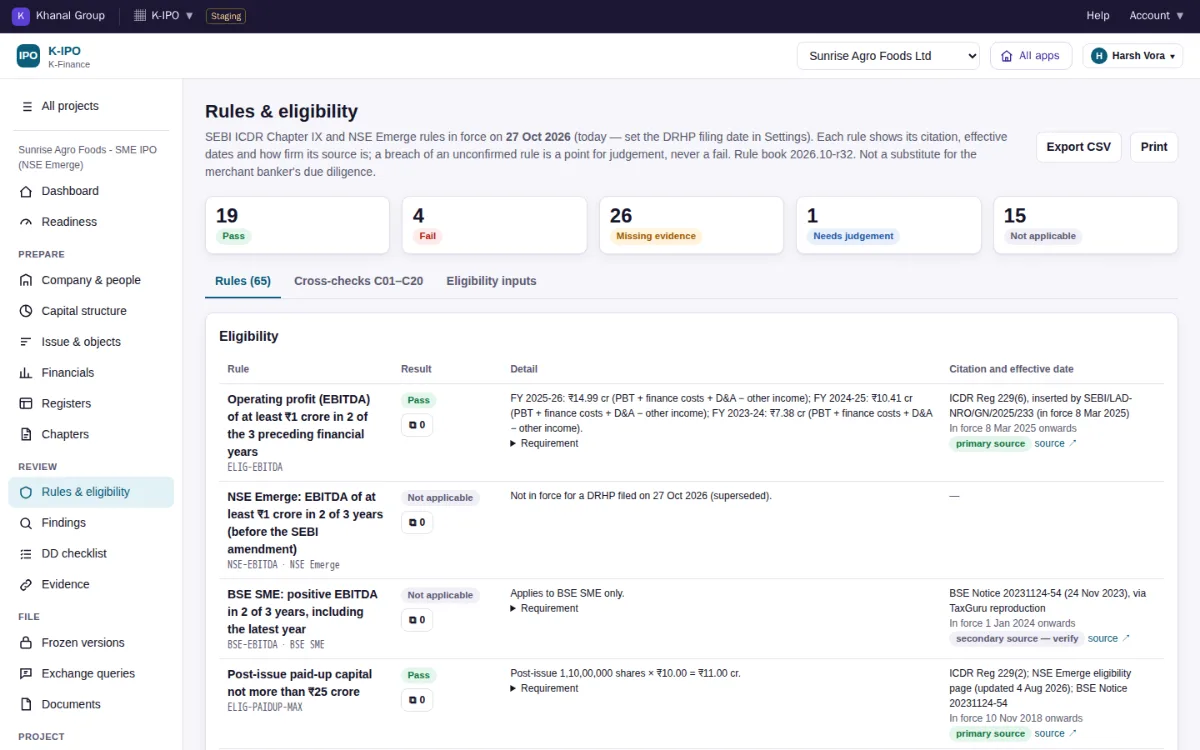
Rules that pass, fail, miss evidence, need judgement or do not apply.
Rules, the cross-checks C01 to C20 and the eligibility inputs.
The working behind each result, from the project’s figures.
Each rule’s citation, effective date and how firm its source is.
Rules and eligibility
The SEBI ICDR Chapter IX and SME platform rules in force on the filing date, each with its citation and how the project’s figures meet it: pass, fail, missing evidence or needs judgement. Checks never change your data; they list what disagrees.
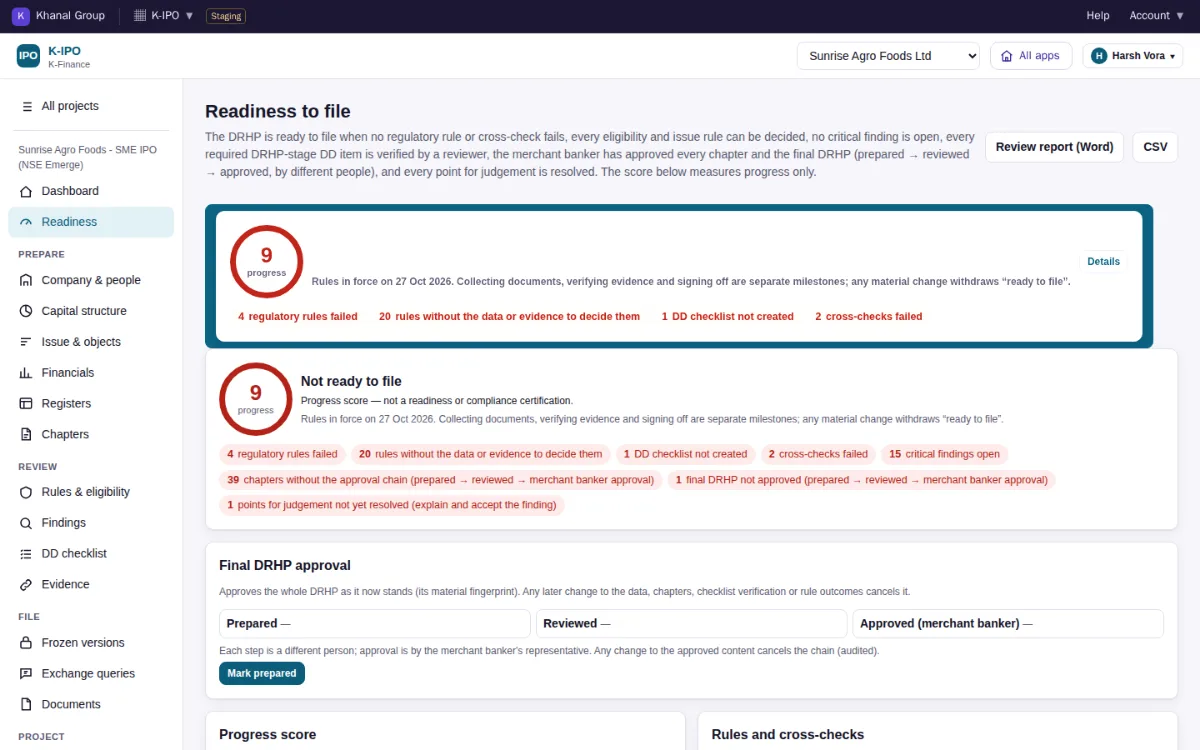
When the DRHP counts as ready to file, written out in full.
Every reason it is not ready yet: failed rules, missing evidence, open findings, unapproved chapters.
Final approval in three steps by different people: prepared, reviewed, approved by the merchant banker.
A review report in Word, or a CSV.
Readiness to file
What still stands between the draft and filing: failed rules, undecided points, open critical findings and the DRHP approval chain (prepared, reviewed, approved by the merchant banker), with a review report in Word.
What it does
Readiness workstreams
Track the finance, secretarial and legal workstreams that a listing requires.
Document uploads
Collect the documents each workstream needs, with status.
Open-item tracking
See what is outstanding, who owns it and what it is blocking.
Data handling. Runs inside the same secure sign-in as K-Finance; each company's IPO workspace is a separate organisation.
Google Drive or OneDrive: your organisation’s own drive, through connected storage (folder 03 - K-IPO). Files linked earlier through the K-IPO Google Drive link stay readable there.
Khanal ID: companies and teams come from Khanal ID, and K-IPO figures appear on the owner dashboard.
Every app and five bundles (CS Firm, Contractor, Construction suite, Business suite and Khanal One) now have published monthly prices; yearly is 10 times the monthly price. With the code FOUNDING26, the first 50 paying organisations of each product that sign up by 31 March 2027 pay half the list price for 12 months, then 75% for the next 12 months. Paid plans start with a 14-day free trial and no card. Prices exclude GST. Payments for apps other than K-MailSign open at launch.
Owners and admins get one page per company on khanals.in with a few figures from each app the company uses, such as bids closing in the next 7 days, late shipments and overdue receivables, each linking into the app. Each person sees only the figures their role in that app allows. A daily email of the same figures can be switched on.
Khanal ID is now the source of companies and teams. A company is created once and people are invited once; K-Finance (with K-Secretarial and K-IPO), K-MailSign, K-Tender, K-Projects, K-CRM, K-Logistics and connected storage pick up the company, its members and later changes. Someone removed in Khanal ID loses access in every app. An organisation that already exists in an app is linked only when its admin chooses to.
One DRHP chapter (a Word or PDF file of up to 100 pages), checked once per organisation by K-IPO's rule-based draft checks, with a read-only report to download or print
Free
—
Per issue
1 IPO project until listing; Founding price for the first 5 issues of each firm
List price ₹75,000₹25,000per issue
One-time payment
Banker firm plan
Up to 5 issues at the same time
List price ₹2,50,000₹1,25,000a year
Billed yearly
Workstreams, due-diligence folders in your own drive, open items and drafts are in every paid plan. Nothing is sold on top of a plan. Founding price with the code FOUNDING26 for the first 12 months, for organisations that sign up by 31 March 2027 (first 50 per product); then 75% of list in months 13 to 24, then list. Yearly = 10 × monthly, for 12 months. Prices exclude GST. Trial: the first chapter check is free; no self-serve trial of the paid plans; no card needed. Payments open at launch; start a free trial now. All apps, bundles and the offer: pricing.
Questions
What does K-IPO actually track?
The readiness workstreams a listing requires (restated financials, secretarial clean-up, legal due diligence, offer document inputs), the documents each needs, and who owns each open item.
Is it a replacement for a merchant banker or legal adviser?
No. It is the working desk where the company and its advisers see the same list; the merchant banker, auditors and lawyers remain responsible for their work.
Which exchange platforms does it cover?
It is built around the BSE SME and NSE Emerge process; the free eligibility checker on this site covers both platforms' published criteria.
How is confidentiality handled?
Each company's IPO workspace is a separate organisation inside the same secure sign-in as K-Finance; advisers are invited per company.
What does the free chapter check look at?
One chapter of your draft, once per organisation and once per person, as a Word or PDF file of up to 10 MB and 100 pages. Rule-based checks (no generative AI) look for totals that do not add up; % changes stated in a sentence or a table that do not recompute, and the increase or decrease wording of such a sentence; the same item for the same period with two values, where one of them is in a table row; impossible dates, placeholders, tracked changes and comments, and DINs with the wrong number of digits; where the chapter holds what they need, also ratio changes above 25% with no reason, terms missing from Definitions and Abbreviations, CSR spend below the amount stated and abridged-prospectus word limits. A Word file is checked more fully than a PDF: in a PDF only the text is read, so the table checks (totals, % change columns, one value per item, ratios) run on Word files. Each finding names its rule and the page (PDF) or paragraph (Word). It does not compare the chapter with your company's records, other chapters or the SEBI eligibility rules: an IPO project does. The file goes to your organisation's own Google Drive or OneDrive; the report itself (headings, short quoted passages and figures) is kept in K-IPO. It is an automated aid, not legal or SEBI advice.
What does it cost?
The first chapter check is free. At the Founding price, one issue is ₹25,000 one-time (list ₹75,000; for the first 5 issues of each firm) and the banker firm plan, for up to 5 issues at the same time, is ₹1,25,000 a year (list ₹2,50,000). Prices exclude GST. There is no self-serve trial of the paid plans.